What is accepted as fact
Objects, attributes, and relationships establish the enterprise’s accepted account of its work. Each conclusion remains connected to its evidence and acceptance history.

THE ARCHITECTURE
A shared foundation for accepted facts, evolving meaning, and accountable action—grounded in evidence and immutable history.
Objects, attributes, and relationships establish the enterprise’s accepted account of its work. Each conclusion remains connected to its evidence and acceptance history.
Schema defines the concepts and relationships used to interpret activity. Definitions can evolve through governance while earlier accepted meaning remains traceable.
Explicit authority governs acceptance, schema and policy changes, and permission to act. A plausible interpretation does not grant itself that authority.
From the White Paper: Section 3: the three pillars.
Fleks records activity as evidence. Interpretation applies the adopted schema and relevant policies to propose facts and relationships. Review and acceptance establish trusted context. Actions taken within explicit permission generate new activity, beginning the cycle again.
Interpretation can also reveal a missing concept or an opportunity to improve a policy. Those proposals pass through their own governance and acceptance boundaries before becoming adopted schema or policy.
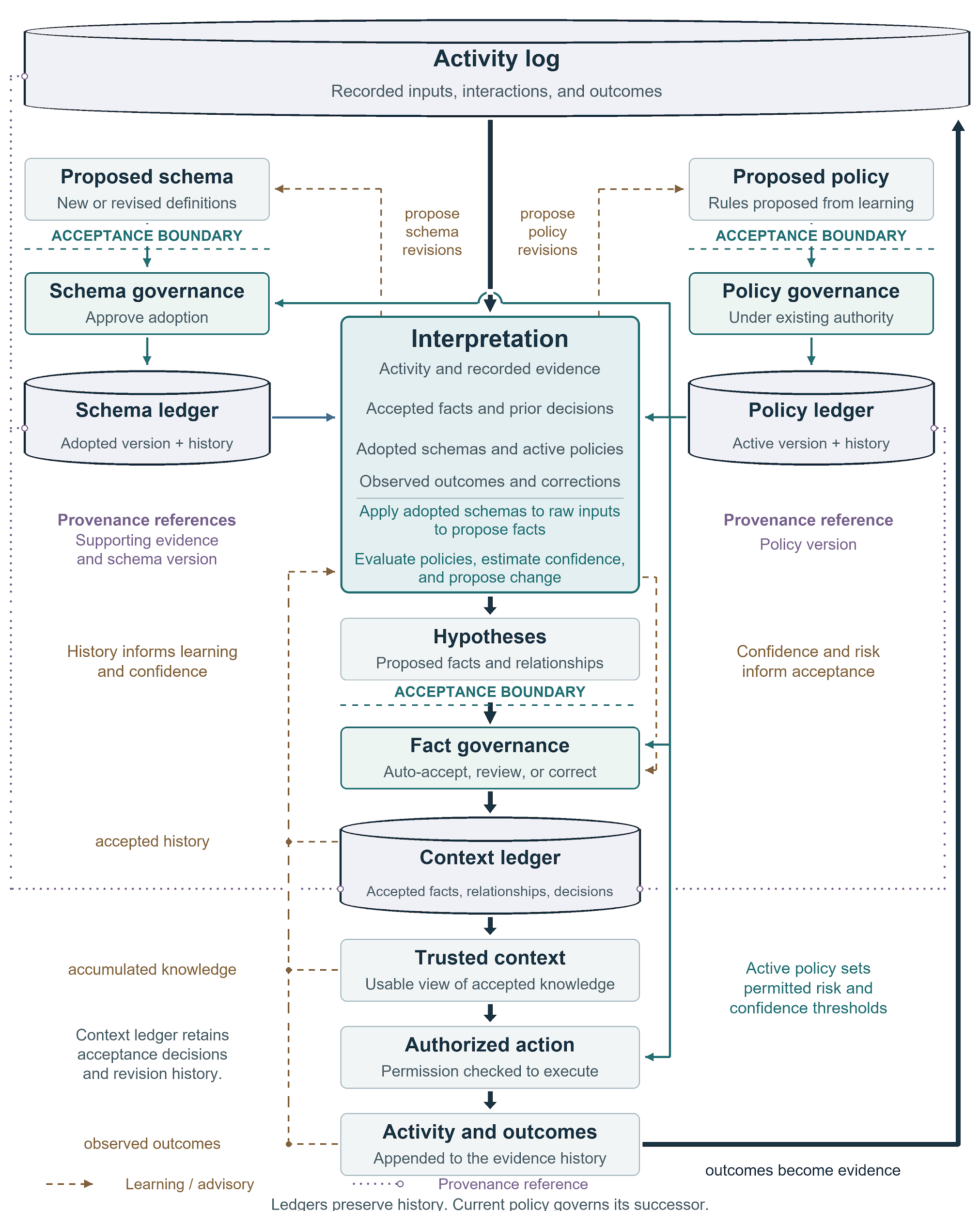
Action generates new activity, and the cycle begins again.
Alongside the cycle: Schema and policy proposals pass through their own governance boundaries. Adopted definitions and policies inform interpretation and decisions. Provenance connects conclusions and decisions to their history.
From the White Paper: Section 4: transforming activity into trusted context.
Source activity, proposals, accepted conclusions, and governing decisions form a connected record. Provenance makes it possible to inspect how a conclusion arose and which definitions and decisions shaped it.
Corrections and new interpretations add to the record. They should preserve the earlier evidence, meaning, and decisions that explain how the enterprise reached its current state.
Fleks is designed to remain schema-literate and domain-blind. Business concepts are supplied through typed schema, plain-language definitions, and role guidance. The same semantic architecture can interpret different kinds of work within its supported schema constructs.
New use cases still need appropriate definitions and evaluation. The goal is to extend the foundation through governed concepts, without adding a separate interpretation path for each business domain.
From the White Paper: Sections 6–7 and Appendix B: open architecture and design tenets.